Melbourne is both a fair and unfair place. But what does ‘fair’ mean? According to the Heinemann Australian Student Dictionary, fair simply means to be honest or in accordance with the rules. Based on that definition, it is reasonable to say that Melbourne is a fair place. However, to the poorer and richer people, these rules are mostly unfair. There are some concessions for poorer people, as seen on our trail on Friday but hardly any for the rich or middle-class. The Magistrate’s Court does alter sentencing, depending if people are dependent on the accused. One man stole some clothing and got fired from his job as a security guard. He was supporting his family and got off with a good behaviour bond because the people he was supporting needed him to help them survive.
Melbourne is unfair to the less-fortunate people of the city. On Wednesday’s trail, we visited Frontyard Youth Services which provides ‘integrated services to address the physical, social and emotional needs of young people aged 12-25 who spend time in Melbourne’s CBD’, basically meaning it provides assistance to young homeless people. We discovered that although Melbourne has many provisions in place to help the poorer people, there are hardly enough for the growing population of poorer people. Centrelink payments to young homeless people are only $201 a week, making it difficult to survive. In addition to that, the cost of staying in a hostel per night is around $188. This data came from Frontyard, a service run by Melbourne City Mission, which should be a reliable source. The amounts may be different from real life amounts to help promote the need for assistance in the area of youth homelessness but the information should be mostly truthful. In the last decade, the number of young homeless people has more than doubled and now stands close to 10,000, proving that Melbourne needs to help the less fortunate people more.
Some might argue that the poorer people should work to make their own money so that they can afford a home but many do work and it is often very complicated. People do not become homeless because they want to, there are usually many factors contributing to them becoming homeless. In order to sustain themselves, they need to have an income and when they begin searching for employment, an obstacle they must overcome is competing against smarter people with higher qualifications for the same job. This often proves difficult and it can be extremely hard for people who do not have an extensive education to get a job. And even if they manage to become employed, it is exceptionally difficult to maintain the job. According to Melbourne City Mission, only 51% of homeless youths stay in the Victorian School System. This number seems about right as many would not have the means to pay for school or the transport to get there, but the number may actually be higher because no one can count the exact number of homeless youths or the number of them still attending school. What should be happening is finding out why more people are becoming homeless and try to stop them from sleeping rough, not focusing all the attention on getting people out of the situation.
Our city is also unfair to the rich. It makes sense that the rich should give money to the poor but how much is too much? The rich people worked very hard to get to where they are now and, more often than not, are deserving of their high wages. They should be able to use more of the money that they worked for and not have to pay so much in taxes. According to the Australian Taxation Office website, an Australian resident who earns more than $180,000 (July 2014-15) has to give more than 30% away in taxes. This 30% starts from $54,547 and only increases with the increase in wage. The money taken away could be better used to buy an apartment or a car or be donated to charity. Instead, it is instead going to the government, and what they choose to use it for may not be going towards what you want. The Australian Taxation Office website is reliable as many people go on it to find out how much they will be taxed. It is true that without the taxes, society would not be able to function and the poor people would only get poorer without the assistance from the government, but is excessively taxing the rich the way to solve the problem?
Melbourne is a fair place if you have a reasonable amount of money. As soon as you only have a bit or have too much, the city makes you pay in its own way. Some poor people end up homeless and the rich people have to give so much money away in taxes it does not matter that they have a high income. Melbourne is fair to most, but for some, Melbourne is an imbalanced city.
Sources
melbournecitymission.org.au/services/homelessness/young-people-25-years/frontyard-youth-services
https://www.ato.gov.au/individuals/income-and-deductions/how-much-income-tax-you-pay/individual-income-tax-rates/
http://www.melbournecitymission.org.au/docs/default-source/Fact-sheets/youth-homelessness-fact-sheets.pdf?sfvrsn=0
 The biggest a-ha moment this week was resume writing, even though I missed half of the double because of guitar. Resume writing was one of my learning goals and I think that I have definitely improved. Now I have a pretty good understanding of what to include and how to express my information whereas previously, I had no idea where to start. I think that it had the most to do with my own self-awareness and growth as I improved on one of my skills. It could be linked to what is going to happen in the future though because I will apply for jobs in the future and use my resume writing skills to complete my resume.
 I found it quite easy to settle back into the rhythm of school after camp. I like the fact that we have toilets at school; we didn’t have proper toilets for most of camp. I think that I am definitely closer to some people from 9C2, mainly the ones in my cooking group or walking group. I also strengthened my relationships with the people in 9C1 on my walking group, just by talking to them on the bus and the hike. I feel more comfortable around some people, not that I wasn’t comfortable before, but I feel like I know what I can talk to them about and there won’t really be many awkward silences.
 The highpoint of my week was Wednesday’s trail when I went to the Japanese Embassy and HSBC. I won a lucky dog at the embassy for being the last one standing in a quiz, as well as a chocolate. At HSBC we also had two quizzes and I was in a team with Lucy, Milly and Patrick. We didn’t win but it was heaps of fun! They also had a really nice assortment of biscuits for us at HSBC. I must have been having a lucky day because at a tram stop, I found an unused $30 gift voucher for food. It would be hard to pick one highpoint of my week so I would say that Wednesday as a whole was my highpoint.
 I feel like I have learnt a bit that I didn’t know before but I feel like I could have just as easily accessed them in a classroom. Most of the things I learnt were from quizzes so the information would have been easy to get in a classroom, provided that it was related to the subject. I did, however, listen to a couple of very inspirational speeches which I wouldn’t have heard usually, from one of the men at HSBC. His speeches were mainly about life and waking up and realising your potential.
  My hopes for the remainder of the term are that we get to go the State Library more often because we have only been once so far and I happened to be sick on that day. I also would be interested in spending more time in the CBD than around it because one of my areas of knowledge is related to Melbourne’s streets. I would like my knowledge to be more on the CBD than in a suburb which I would hardly ever visit.
 A skill I improved on was caving. I had never been caving before so I definitely improved and learnt how to cave properly and safely. An area of knowledge I developed was map reading. I already knew how to read a map and use a compass but I think I improved and now I have a better understanding of how to orient yourself and find yourself on a map. Surprisingly, I only developed one of my learning goals, collaboration. Outdoor skills was not an objective of mine because I had other priorities, but if it would have been, my other more developed areas would be linked to that.
 A challenge I overcame was setting up a tent with frozen fingers. That probably won’t come in handy very often but hiking might. The 12km hike was one of my highlights and I enjoyed it very much, apart from getting whipped by ferns in the face. Walking through the mud was hard work because it was hard to know where to step but standing on solid ground looking back at the mud, I felt good because I did it.
 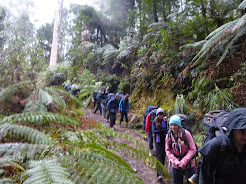 A challenge I overcame that might come in handy in the future was carrying a heavy pack on my back for hours. My schoolbag is often heavy and I carry a lot of things on my back so by hiking with a heavy pack, I hopefully strengthened my back.
 The Yarra in Warburton was very blue and crystal clear whereas the Yarra in Melbourne’s CBD is brown and yucky. This is proof that we need to do more in the CBD to help the beautiful river. My message for people to help look after the Yarra more would be put all your rubbish in the bin and try to use vehicles that don’t have oils that can pollute the Yarra and use bikes or trams or trains instead.
 My understanding of the justice system is now more complete and I have a better understanding of how the convictions work. The trip to the court was very educational, and I got to see real people get convicted. One new thing I learnt was that every case goes through the magistrate’s court in one form or another.
 give it to the poor but then the rich people won’t have the money that they worked hard for and then people may stop working hard. I believe that finding the right balance is an ongoing battle and will be for a long time.
 I have learnt that teamwork is very important. I was in charge of the Popplet and it was sometimes difficult to get members of my group to email me their research as they wouldn’t reply to texts and seemed to be ignoring me. I think that I contribute my ideas to my group pretty well and keep everyone on track but our group doesn’t have an uneven workload.
 An ethical dilemma I faced was I saw someone writing on their hand so that they could look at their notes during a test. I didn’t know if I should say something or not. I didn’t say anything about it to anyone, and one of the reasons I didn’t say anything was that others had seen the person in question writing on their hand but they didn’t say anything. I guess that the belief that underpinned my decision was that I didn’t want to be the one who told on the person as other people were watching them too. I think the principle that stopped me from saying anything is I don’t like being the odd one out. Another reason I didn’t say anything was because if they cheated, they were only cheating themselves and making it harder for themselves in the future by not actually learning anything. If I got to relive the situation, I don’t think I would act differently. As I said above, they were only cheating themselves which may make it easier for them in the test but in the long term, it will be harder because they won’t be able to cheat and they haven’t actually learnt anything.
 My standout experience this week would have to be the session on the ethics of sport. I enjoyed the more practical side of it when we went to the park more than the actual presentation. At the park I enjoyed playing keepings-off against the guys even though it started unintentionally as both the guys and the girls wanted the ball. I am proud to admit that the girls won, even though there were only four of us, as we finished with the ball.
 Mini trail was great! After leaving school nearly 15 minutes behind schedule, we left our first location, The Royal Children’s Hospital, on time. We did some surveying which will hopefully provide some answers to the questions that we set out with. It started raining when we were at St. Vincent’s Hospital so we left a little early so we could get out of the rain as soon as possible.
 I was happy with the quality of information we collected as we surveyed both medical professionals and members of the general public. I believe that this would have shown the contrasts between the medics’ opinions and people working in other fields’ opinions as we also asked the people what their profession is. Altogether, we surveyed around 20 people, which is a great effort considering we are a group of four.
 Galileo